
Ag Minute: 2026 Outlook for Corn and Soybean Farmers
Updated: Feb 20
There are few certainties in farming aside from death, taxes, and frustration. Depending on the year, the amount of taxes and frustration may vary, but both are guaranteed. Meanwhile, the weather, commodity markets, and input prices can fluctuate dramatically from season to season. With many area farmers already applying fall fertility, the 2026 crop year has effectively begun. While no one can predict exactly how the year will unfold, early projections suggest 2026 financials could be grim compared to the past few years for corn and soybean producers.
As of Thursday, February 19, December 2026 corn futures were trading at $4.61 per bushel and November 2026 soybean futures at $11.17. These are not disastrous prices considering the large 2025 crops and challenging export conditions, but they are far from the $8 corn and $14 (or higher) soybeans many remember in the post-COVID surge. The University of Illinois, through its farmdoc daily series, publishes annual crop budgets to help producers evaluate costs and returns. The most recent 2026 revision was released January 13. Using the USDA’s January WASDE report, projections estimate 2026 corn prices at $4.25 per bushel and soybeans at $10.40. After factoring in local basis, those estimates align reasonably well with current end-of-year futures prices. In addition, government payments are projected to average about $56 per acre across corn and soybeans for Central Illinois farms.
On the expense side, input costs remain elevated. Fertilizer is expected to be the largest non-land expense for corn producers, projected at $229 per acre on highly productive Central Illinois ground. Total variable costs — including fertilizer, seed, pesticides, drying, storage, and crop insurance — are estimated at $521 per acre for corn. At projected prices, that means producers would need approximately 123 bushels per acre just to cover variable costs.
Power costs (machinery, fuel, oil, and utilities) are projected at $176 per acre for corn and $155 for soybeans. Overhead expenses, driven largely by labor and operating interest, are estimated at $111 per acre for both crops.
Altogether, farmdoc daily projects total non-land costs of $808 per acre for corn and $490 per acre for soybeans. To break even at projected 2026 prices — before government payments — corn would need to average 190 bushels per acre, while soybeans would need 47 bushels. For highly productive Central Illinois farmland, those yields are achievable. However, land costs quickly narrow profit margins. The University of Illinois estimates land costs at $327 per acre in the region. Including those costs pushes the breakeven yield to 266 bushels per acre for corn and 78 bushels per acre for soybeans. Projected yields on this type of ground are 241 bushels for corn and 76 bushels for soybeans. At those levels, returns are estimated at negative $55 per acre for corn and positive $25 per acre for soybeans. The graph below highlights how the projections for 2026 compares to previous years dating back to 2000.
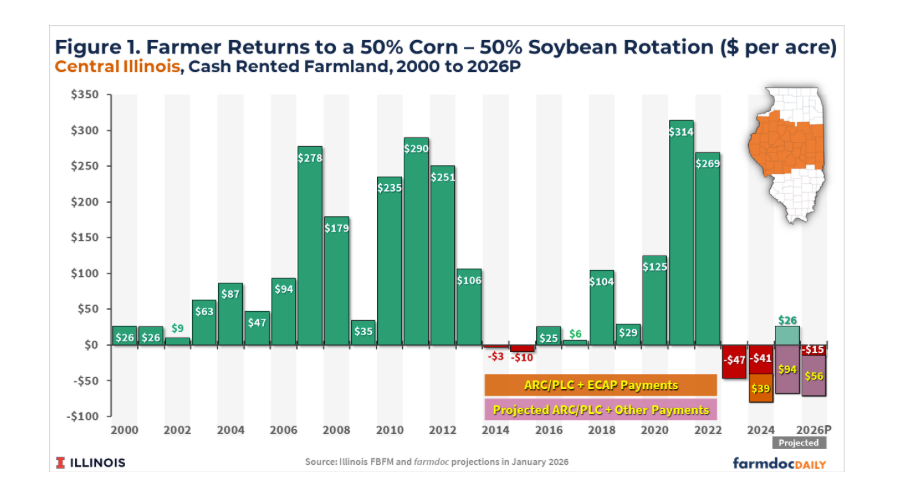
Source: Paulson et al., 2026
Farmers have faced tighter margins in recent years, and current projections suggest another challenging season ahead. While not all producers have costs as high as those used in these estimates, the budgets serve as an important benchmark. Carefully calculating cost of production and breakeven prices can guide marketing decisions — particularly for producers without detailed internal budgets. With low or negative projected returns, 2026 will require disciplined cost management across every category, from fertilizer to overhead, as well as strategic pricing decisions. The year ahead may be financially tight, but with careful planning and informed marketing, many producers may still find a path to modest profitability.
To see the farmdoc daily publication for 2026 production budgets, follow the link below;


