
Ag Minute: Why does Conflict in the Middle East Cause Trouble for Fertilizer Prices
Heading into 2026, many corn and wheat producers were already dealing with elevated fertilizer prices, nitrogen in particular. Prices aren’t at the extreme levels seen during COVID supply chain disruptions or the start of the Russia-Ukraine war, but they remain higher than what we’ve seen in the last few years. Now, renewed conflict in the Middle East is adding another layer of pressure. While some geopolitical tension had already been priced into energy markets, the recent disruption in the Strait of Hormuz has pushed prices higher in a short period of time. Most people expect diesel and fuel costs to rise in a situation like this, but why does nitrogen fertilizer follow so closely behind?
To answer that, it helps to go back over a century. In 1913, the Haber-Bosch process made it possible to convert atmospheric nitrogen into ammonia. Nitrogen is abundant in the air, but plants can’t use it in that form. Through the process developed by Fritz Haber and scaled by Carl Bosch, nitrogen can be transformed into ammonia, which can then be applied directly as anhydrous ammonia (82-0-0) or further processed into urea (46-0-0). This breakthrough has been critical to modern agriculture, allowing for the production levels needed to feed a growing global population.
However, there’s a catch, and that is that this process is incredibly energy intensive. Producing nitrogen fertilizer requires large amounts of natural gas, both as a fuel source and as a key input in the chemical process itself. High heat, high pressure, and multiple refining steps all depend heavily on energy. Because of that, nitrogen fertilizer prices tend to move closely with global energy markets
This is where the Middle East comes into play. Countries in the Persian Gulf hold major reserves of both oil and natural gas, and many have become key exporters of nitrogen fertilizer like urea. Much of that product moves through the Strait of Hormuz, one of the most important shipping lanes in the world. When that route is disrupted, as it has been recently, it creates immediate challenges for global supply.
Even though the U.S. is the world’s largest producer of natural gas, global markets are still interconnected. Iran and other regional producers account for about 10% of global supply, and when production or shipping is threatened, prices react quickly. On top of that, nearly half of the world’s urea exports originate from the Middle East according to the AFBF, making the region even more critical to fertilizer availability.
Farmers and agronomy services are already seeing the impact here at home. A recent report from DTN reporter Russ Quinn shows the elevated fertilizer prices in the U.S. as farmers prepare to apply nitrogen to corn crops for the season, particularly if they didn’t apply anhydrous ammonia in the fall. UAN28, a common liquid fertilizer used across Illinois is up 13% already in March relative to February. UAN32 as shown in Figure 1 is above 24, 25, and 5 year average prices at $489 per ton, or about $0.73 per pound of nitrogen.
Because of this, some corn on corn acres across the Midwest may get a last minute switch to soybeans due to their profit level being slightly higher than that of corn, particularly with their ability to fix nitrogen on their own. Looking ahead, much depends on how long disruptions in the Strait of Hormuz last and whether production or infrastructure in the region is impacted further. What happens half a world away can quickly show up in input bills here in the Midwest. For producers, it’s a reminder of just how connected agriculture is to global energy and geopolitics, exhibiting just how quickly those forces can shift the economics of a growing season.
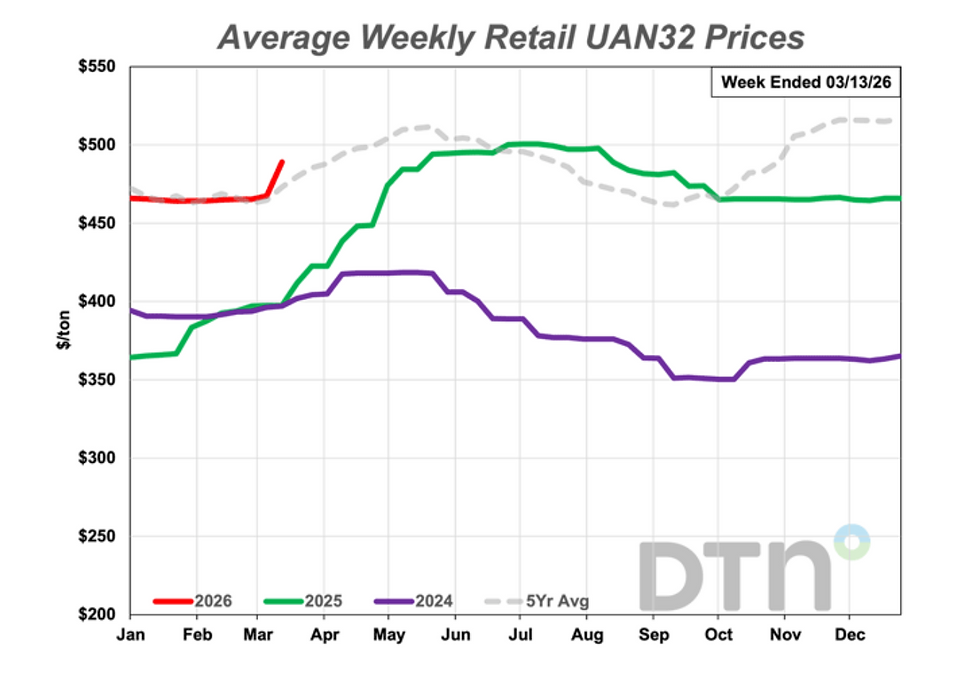
Figure 1: DTN chart showing UAN32 prices at the start of March.
To see the recent DTN update regarding nitrogen fertilizer prices in the U.S., follow the link below;
To read Carl Bosch’s bio and the history of the Haber-Bosch process, follow the link below;
To read more about the scientific process of converting air into nitrogen fertilizer, follow the link below;
To see a list of where the world’s natural gas is coming from, follow the link below;
To better understand global fertilizer markets, follow the link below;


